

Archaeological
Sites
Past till Future
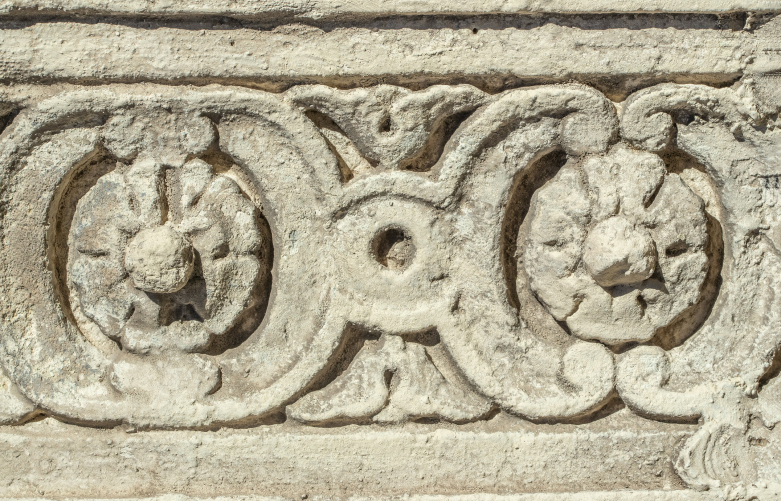
Santorini’s archaeological sites and museums provide a captivating window into the island’s ancient past, with the prehistoric city of Akrotiri revealing remarkably well-preserved Minoan frescoes and buildings buried by volcanic ash, while the Archaeological Museum of Thera displays artifacts spanning from the Proto-Cycladic era to the Hellenistic period, including pottery, sculptures, and everyday objects that offer insights into the life and culture of early civilizations that once thrived on the island.
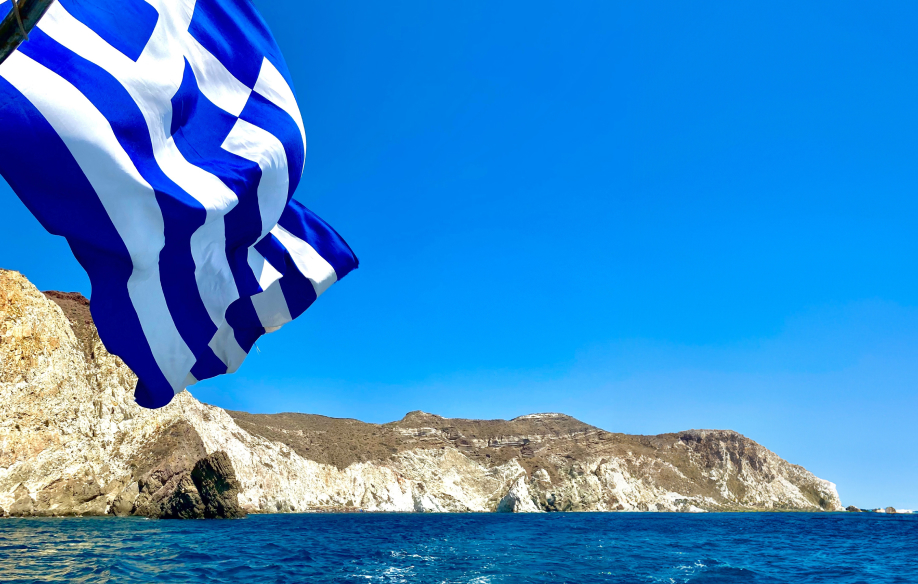
Perched on Mesa Vouno at 396 meters above sea level, Ancient Thera was founded in the 9th century BC by Dorian settlers led by Theras, with habitation lasting until the early Byzantine era. The site, naturally fortified by the steep slopes of the mountain, provided both security and an exceptional vantage point over the southeastern Aegean Sea.
Excavations, primarily focused on areas built during the Hellenistic period, reveal a well-organized city layout. A main road runs northeast to southeast, with smaller cobbled streets adapting to the terrain and connecting different sections. Due to the sloping landscape, buildings were constructed amphitheatrically, ensuring sea views for many residences.
Few private houses have been excavated, mostly in the eastern part of the settlement, where neighborhoods were arranged around central courtyards with underground rainwater tanks. The size and layout of homes varied, with some having multiple rooms or second floors, reflecting the social and economic status of their owners.
(Information based on the research of archaeologist Angeliki Birtacha, from the book “Santorini: And the Sea Brought Forth the Earth”, Topio Publications).
ANCIENT THERA
A timecapsule of Hellenic Glory
Key Monuments
Ancient Thera
Sanctuary of Artemidoros
Carved into the rock by Artemidoros of Perge, an admiral of the Ptolemaic fleet, this sanctuary features inscriptions and symbols dedicated to the gods worshiped at the time.
The Agora
The city’s central hub, with its southern section serving as the commercial center, the middle area housing administrative buildings, and the northern part, constructed during Roman times, featuring monuments, a stoa, and temple-like structures.
The Royal Stoa
(1st Century AD)
Located at the southwestern edge of the Agora, this structure dates to the reign of Augustus. Statues of the Caesar’s family once adorned its northern side, while inscriptions on the western wall record a restoration by Cleitosthenes in 149 AD.
Temple of Dionysus
(3rd Century BC)
A small Hellenistic Doric temple north of the Agora, dedicated to Dionysus. Its façade and roof were marble, while the rest of the structure was built from local stone.
The Area of the Sanctuaries
Located at the southeastern edge of the city, this area consists of open-air and covered sanctuaries dedicated to Apollo Karneios, Hermes, Hercules, Ptolemy III, and others. A square within this area was used for the Gymnopaediae festival, held in honor of Apollo Karneios. Numerous inscriptions from the Archaic to Roman periods are engraved on the rocks.
Sanctuary of Apollo Karneios (6th Century BC)
A partially rock-hewn sanctuary with a temple, a square yard, an underground cistern, and a small building, possibly used as a sacristy.
Gymnasium for Ephebes
(2nd Century AD)
Situated on the southern side of the city, this gymnasium includes a partially rock-hewn cave, dedicated to Hermes and Hercules.
The Cemeteries
The cemeteries of Ancient Thera stretch across the hillsides of Sellada, along the roads leading to the ancient city’s northern and southern ports, now modern Kamari and Perissa. Burials spanning from the Geometric to Roman periods have been uncovered here.
Τhe Theatre
(3rd Century BC)
Built during the Ptolemaic era, this theatre stands on the southeastern side of the Agora. In the 1st century AD, its stage was expanded, partially covering the original orchestra area.
Visitor Information
Opening Hours: 08:30 – 14:30 (Closed on Mondays)
Contact: For inquiries, please contact the Museum of Prehistoric Thera at +30 22860 23217
Excavations & Discoveries
Ancient Thera and most of its cemeteries were first excavated by German archaeologist Friedrich Hiller von Gaertringen between 1895 and 1902, while the Sellada cemeteries were explored by N. Zafeiropoulos from 1961 to 1982.
In November 2000, archaeologist Charalambos Sigalas uncovered a remarkable Daedalic-style Kore statue, dating back to 600 BC, in the ancient cemetery.
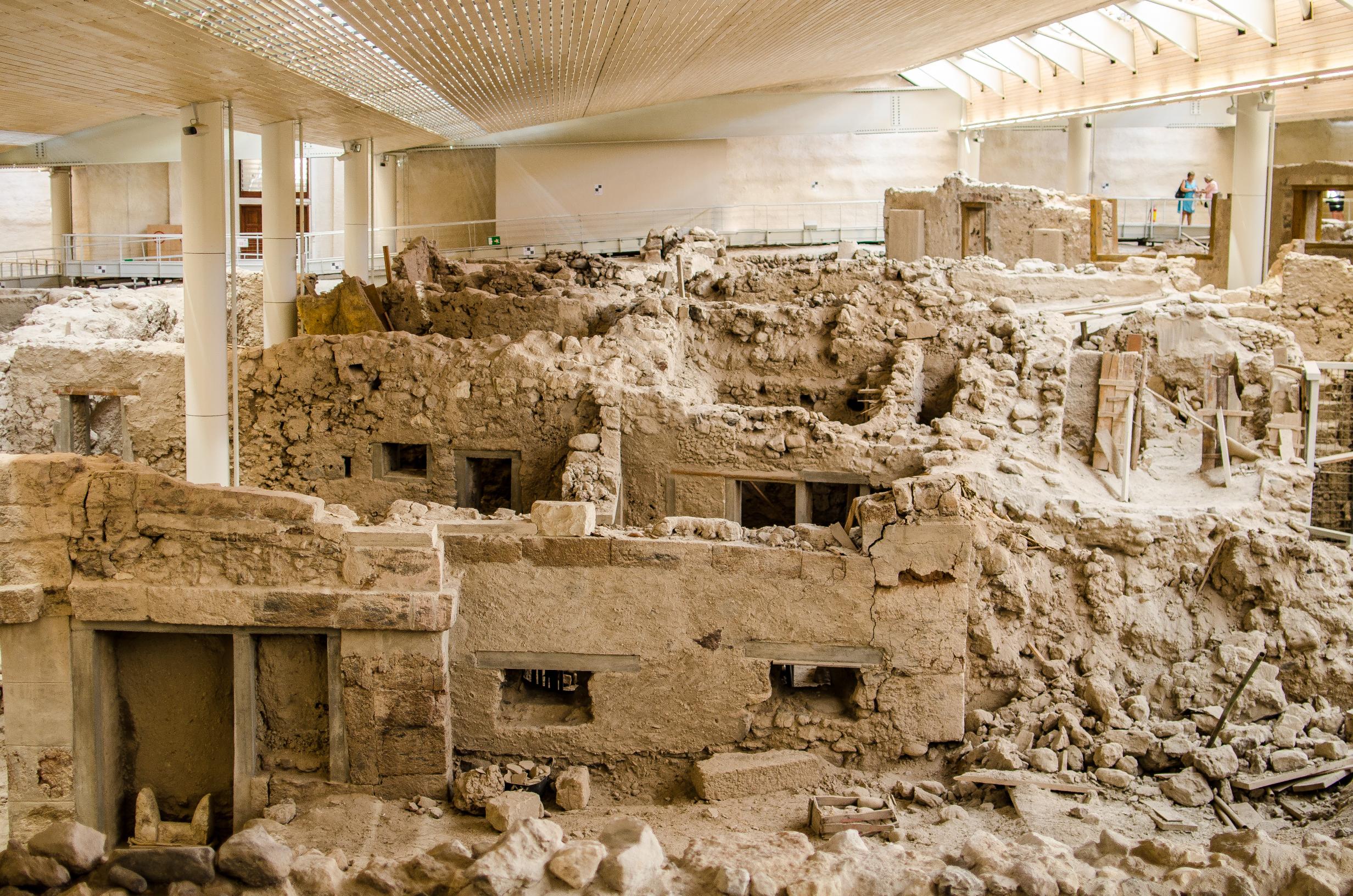
Akrotiri is one of the most important archaeological sites in the Aegean, with excavations dating back to 1967. Located 15 km from Fira, at the southwestern tip of Santorini, this prehistoric settlement was remarkably well-preserved under volcanic ash. After years of restoration, the site reopened to visitors in April 2012 with a new protective roof.
Akrotiri was first inhabited in the Late Neolithic Period (4th millennium BC) and grew into a major urban center of the Aegean by the 20th-17th centuries BC. Covering 50 acres, it featured advanced infrastructure, an elaborate sewage system, and evidence of extensive trade with Minoan Crete, the Greek mainland, Cyprus, Syria, and Egypt.
Its prosperity ended in the 17th century BC when seismic activity forced inhabitants to flee before the volcanic eruption buried the town, preserving its buildings and artifacts. Excavations began in 1967 under Professor Spyros Marinatos, who aimed to prove his theory that the Santorini eruption contributed to the collapse of Minoan civilization in Crete. After his passing in 1974, excavations continued under Professor Christos Doumas.
AKROTIRI
The history of a secret ancient civilization
Key Monuments
Akrotiri
Large Multi-Story Building
A two-story structure with 14 rooms per floor, many connected by pier-and-door partitions (polythyra) and decorated with frescoes. Notable frescoes include the Crocus Collectors, depicting women gathering crocuses near an altar, and The Altar, which shows offerings made to a seated deity, surrounded by an ape and a griffin. One room contains a Lustral Basin, possibly for ritual use.
Section B
Likely composed of two interconnected buildings, this section housed significant frescoes. The Antelopes and Boxers frescoes come from the western building, while the eastern building is known for the Apes fresco, featuring monkeys climbing on rocky riverbanks.
The West House
A compact but well-organized residence with food storage areas, workshops, a kitchen, and a mill facility on the ground floor. The first floor included a loom room, a toilet, and a storage area. Among its frescoes are The Fishermen, The Priestess, and the famous Fleet Fresco, a miniature frieze depicting a naval expedition visiting coastal cities, with Akrotiri likely being the final destination. Another room is adorned with the Ship Cabins frescoes.
Building Complex D
A four-building complex with a room in the eastern edifice decorated with the Spring Fresco, featuring blooming lilies and swallows in flight. Excavations here also uncovered Linear A tablets, indicating administrative or economic activity. Several significant artifacts were also found across these buildings.
The House of the Ladies
Named after the Ladies and Papyruses Fresco discovered inside, this three-story building is the largest uncovered so far. Its facades are lined with carved chalkstone blocks, and fresco fragments depict a procession of life-sized men carrying gifts up a staircase, suggesting it may have served as a public building.
Visitor Information
Located at the southwestern edge of Santorini, near the traditional village of Akrotiri, this historic lighthouse is considered one of the most beautiful in the Cyclades. Standing 10 meters high on a dramatic cliff above the Aegean Sea, it emits a luminous white light, guiding sailors along the island’s coast.
Built in 1892 by a French company, the Akrotiri Lighthouse is among Greece’s earliest lighthouses. It ceased operation during World War II but was restored and reactivated in 1945 under the supervision of the Greek Navy.